Today’s lead: The San Diego Zoo Safari Park has two baby echidnas from the same mother and the same breeding season, which sounds exactly like the start of a twin announcement. The zoo’s own July 16 report includes one important correction: the puggles are not twins. They are, however, an unprecedented double helping for the North American population in human care.
Two puggles, one very useful asterisk
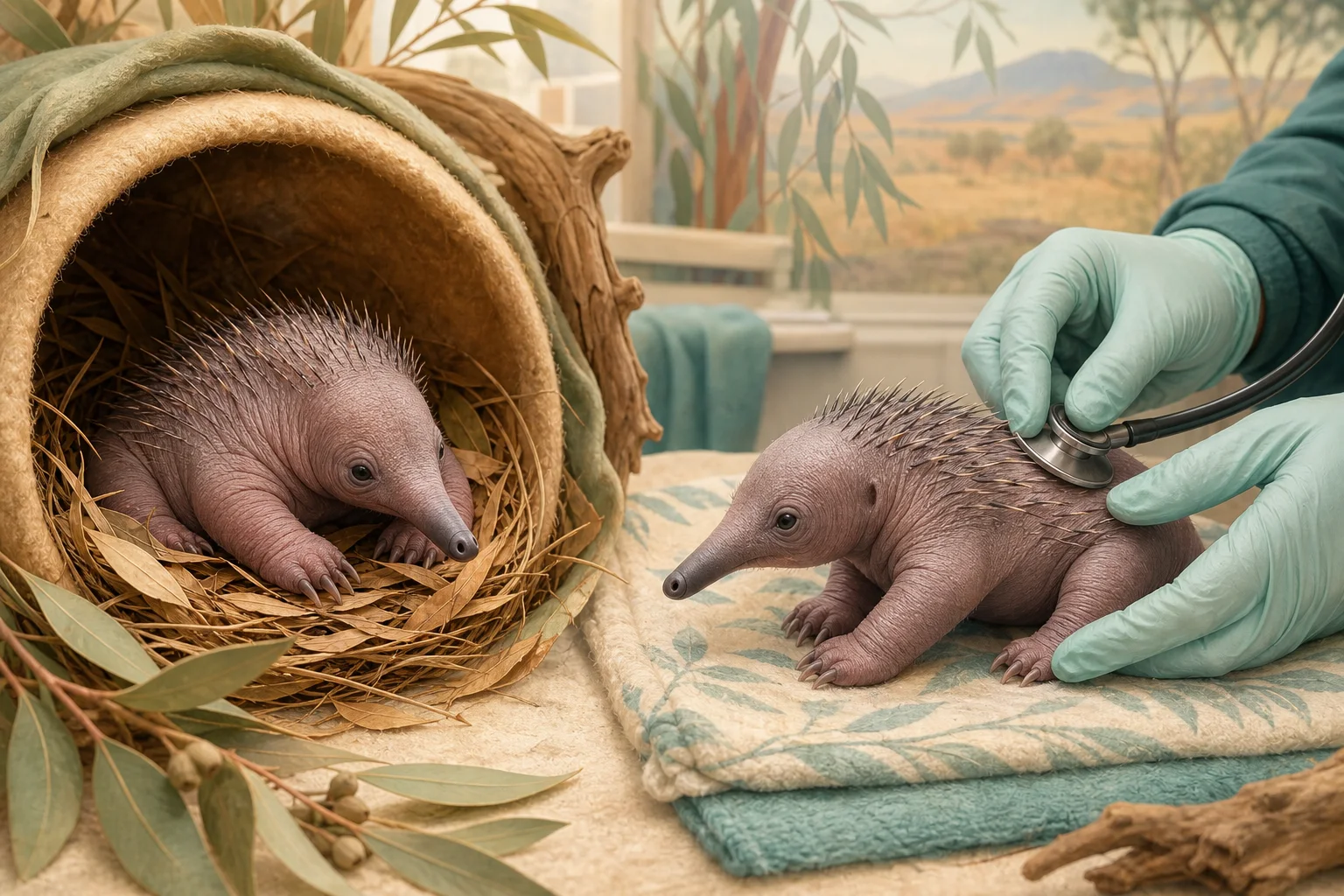
In “Double the Puggle,” published July 16, San Diego Zoo Wildlife Alliance says short-beaked echidna Kathryn surprised the Safari Park team with two puggles in her pouch. Both hatched from eggs laid by the same mother during the same mating season, but the Alliance explicitly says they are not twins.
That distinction has not prevented the story from being adorable enough to require its own vocabulary lesson. A baby echidna is called a puggle. An adult echidna is one of the few egg-laying mammals on Earth. And two puggles sharing a mother and a season are apparently best described as “double the puggle,” a phrase that sounds less like zoology and more like a highly specialized bakery order.
UPI’s same-day report says one puggle is being raised by Kathryn in an underground burrow while the smaller youngster is receiving hands-on care at the Safari Park’s Harter Veterinary Care Center. The care team has used stomach ultrasounds to learn how quickly the youngster digests formula and to refine its feeding schedule.
Half a marshmallow, all mammal
The Alliance explains that an echidna egg incubates in the mother’s pouch and hatches after about ten days. A newly hatched puggle weighs roughly half as much as a miniature marshmallow and has neither spines nor fur. It remains in the pouch for about two months, and at around 40 days the mother begins preparing an underground nursery burrow.
The veterinary work has a purpose beyond one unusually crowded pouch. The Alliance says its teams collaborate with Australian partners and other echidna specialists, and that the ultrasound-based feeding insight will influence care in San Diego and across its Australian Forest Conservation Hub. The headline is “two tiny mammals.” The longer story is “better information for caring for a species that still keeps plenty of secrets.”
A quick lap around tonight’s news network
- Hilarious News: In Arizona, tiny cone ants have been documented grooming much larger harvester ants. Read “Arizona’s Ant Spa Puts Tiny Groomers on the Big Shift.”
- Smile News: Cleveland Metroparks Zoo welcomed its first Amur leopard cub in the zoo’s 144-year history. Meet the history-making cub.
- Weird News: Oxford’s electric bell has been ringing since 1840 while its exact power source remains sealed inside. Explore the long-running mystery.
- Satire from FunnyNews.lol: “Exact Change of Plans” is an original fictional comic, not factual reporting. Read the comic strip.
Sources
- San Diego Zoo Wildlife Alliance, July 16, 2026 — primary account of Kathryn’s two puggles, echidna development, and the care program’s research.
- UPI, July 16, 2026 — independent report on the two puggles and the smaller youngster’s veterinary care.